
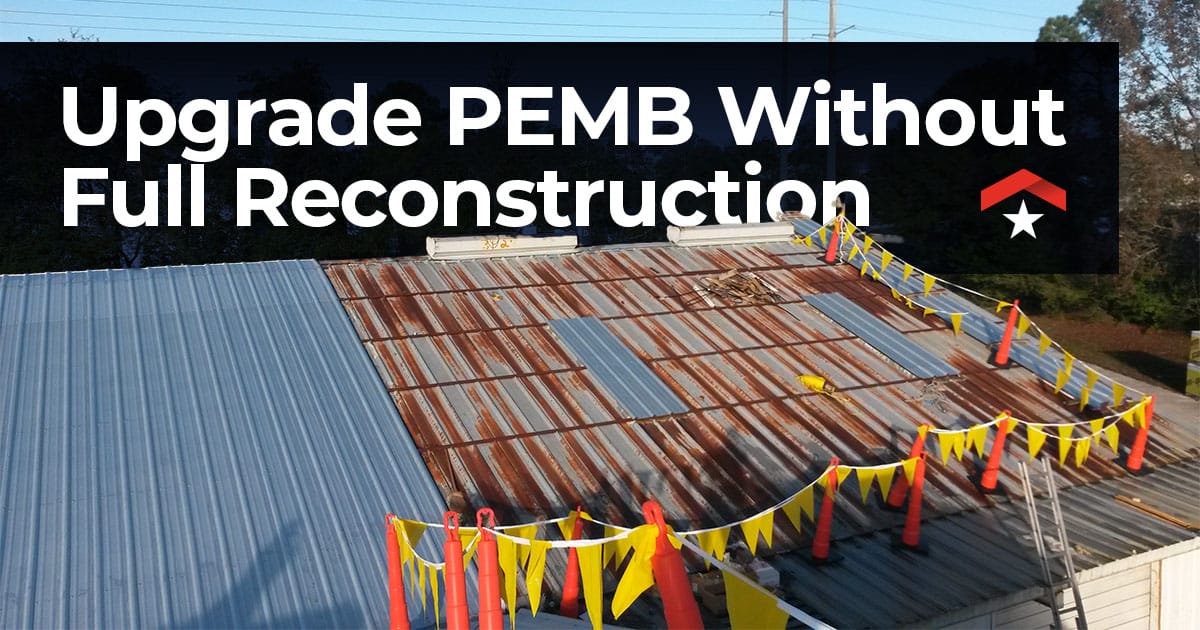
Florida Building Code compliance is one of the most overlooked responsibilities facing owners and facility managers of aging pre-engineered metal buildings across the Central Florida corridor. Your building may have been fully compliant the day it went up. But codes evolve, standards tighten, and a structure that met every requirement in 2005 can fall well short of what the state expects today. The question most building owners eventually face is whether bringing an older PEMB up to current standards means tearing it down and starting over.
In most cases, it does not. Restoration gives Central Florida building owners a path to a code-compliant structure that preserves the existing framework, avoids the cost of full reconstruction, and keeps the business running throughout the process. Here is how it works and what you need to know before the next code cycle takes effect.
What Florida Building Code Compliance Means for an Existing PEMB
Florida operates under one statewide building code, currently the Florida Building Code, 8th Edition (2023), which took effect December 31, 2023. This edition adopted ASCE 7-22, the most current wind load standard from the American Society of Civil Engineers, along with updated wind speed maps that require commercial structures across the state to be designed for sustained winds ranging from roughly 130 to 180 miles per hour depending on location.
For existing buildings, the rules that govern alterations, repairs, and reroofing live in a separate volume called the Florida Building Code, Existing Building. This is the section that matters most to a building owner who is restoring rather than constructing from scratch.
There is also a clock running. The 9th Edition of the Florida Building Code is scheduled to take effect December 31, 2026, bringing further tightening around wind resistance, corrosion resistance, energy efficiency, and water intrusion protection. Work that passes inspection under today’s standards may be evaluated differently once the new edition is enforced, which makes the current window a smart time to act.
The 25 Percent Rule Every Central Florida PEMB Owner Should Know
If there is one provision that catches building owners off guard, it is the so-called 25 percent rule. Under the Florida Building Code, Existing Building, no more than 25 percent of the total roof area or roof section of an existing building may be repaired, replaced, or recovered in any 12-month period unless the entire roofing system or roof section is brought into conformance with current code requirements.
In plain terms, a small patch job stays a patch job. But once the scope of work crosses that 25 percent threshold, the whole roof system or roof section has to meet today’s standards, not the standards that existed when the building was originally constructed.
For a Central Florida PEMB owner, this has real consequences. A roof that has deteriorated across more than a quarter of its area cannot simply be patched piecemeal forever. At some point, the code requires a comprehensive solution. The good news is that this is exactly the moment when a properly engineered restoration delivers the most value, because the work you are already compelled to do can simultaneously bring the structure up to current code.
It is worth understanding the difference between two terms the code uses. A roof recover means installing a new roof covering over the existing one without removing it, which is the basis of a metal roof-over. A roof replacement means removing the existing covering entirely before installing the new system. Both have a place, and which one applies to your building depends on the condition of the structure underneath.
How PEMB Restoration Achieves Florida Building Code Compliance
This is where a qualified restoration contractor earns their keep. PEMB restoration is not a single service but a set of solutions, and each one addresses a different piece of the compliance picture.
Structural repairs reinforce weakened framework and restore the load-carrying capacity of the building. This matters because the code requires that structural roof components be capable of supporting both the new roof-covering system and the loads encountered during installation. A roof-over cannot be installed over a structure that can no longer carry the weight, so structural integrity is always evaluated first.
Metal roof-overs and panel replacement address the roof covering itself. A metal roof-over installs new panels on a custom-engineered 16-gauge sub-girt frame fastened into the existing steel purlins, using fasteners rated for Florida’s wind and moisture demands. Because the new system is specified to current wind load requirements, the roof comes out the other side meeting today’s standards rather than the standards of decades past. The code is clear that a new roofing system cannot be applied where the existing sheathing or fastening is deteriorated or inadequate, which is another reason professional assessment comes before any work begins.
Insulation retrofits target the energy side of the code. Florida’s building code has steadily raised the bar on energy performance, and an insulation upgrade improves thermal efficiency while helping a facility meet current energy provisions.
A complete PEMB ReSkin brings the entire building envelope up to standard at once. New exterior panels across the full structure restore both performance and appearance, addressing wind resistance, water intrusion, and energy efficiency together. The Metal Building Manufacturers Association publishes extensive technical guidance on retrofitting and reinforcing existing metal building systems, reflecting how established these approaches are within the industry.
The common thread is that all of these solutions work with the existing structure rather than demolishing it, which is what allows a building owner to reach compliance without the expense and disruption of full reconstruction.
Why Florida Building Code Compliance Is Worth Getting Ahead Of
Compliance is not just a box to check at permit time. There are real consequences to letting an aging building drift out of step with current code.
Code enforcement in Florida carries financial teeth. Under Chapter 162 of the Florida Statutes, local code enforcement boards can impose daily fines of up to $250 for a first violation and up to $500 per day for a repeat violation, and unpaid fines can become liens against the property that may eventually be foreclosed upon. Those costs accumulate quietly and quickly.
Beyond fines, an out-of-code building creates friction in places owners do not always anticipate. Insurance carriers scrutinize roof condition and code compliance closely in a hurricane-exposed state, and a substandard roof can complicate coverage or claims. Lenders and buyers factor compliance into property valuations. And any future permitted work on the building can trigger a requirement to address existing deficiencies. Addressing compliance proactively, on your own timeline, is almost always less expensive than addressing it reactively under pressure.
When Restoration Is Enough and When It Is Not
Restoration is the right path when the building’s core structure remains fundamentally sound. If the framework can carry the loads and the deterioration is concentrated in the roof covering, panels, fasteners, or insulation, a restoration solution can bring the building into compliance at a fraction of the cost of replacement.
Full reconstruction becomes necessary only when structural deterioration is severe, widespread corrosion has compromised the underlying steel framework, or a building has already been roofed over multiple times and cannot safely support additional material. A professional assessment is the only reliable way to know which category your building falls into, and a reputable contractor will tell you honestly when restoration is not the appropriate answer.
For the large majority of aging pre-engineered metal buildings across Central Florida, though, restoration is both the compliant and the economical choice.
Get a Professional Compliance Assessment Before the Next Code Cycle
With the 9th Edition of the Florida Building Code arriving at the end of 2026, now is the time for Central Florida building owners and facility managers to understand where their structures stand. Roof Over America has served commercial property owners across 14 Central Florida counties since 1983 and holds Florida roofing licenses CCC 1331938 and CGC 1529752. The team specializes in metal roof-overs, PEMB restoration, and structural solutions engineered to meet current Florida Building Code requirements.
If your pre-engineered metal building is more than 15 years old or has not been professionally assessed in recent years, schedule an evaluation now and get ahead of the next code cycle. Call (407) 607-9135 or visit roofoveramerica.com/contact to request your assessment.
Get Started
Related Posts
Categories
Get STarted
"*" indicates required fields