
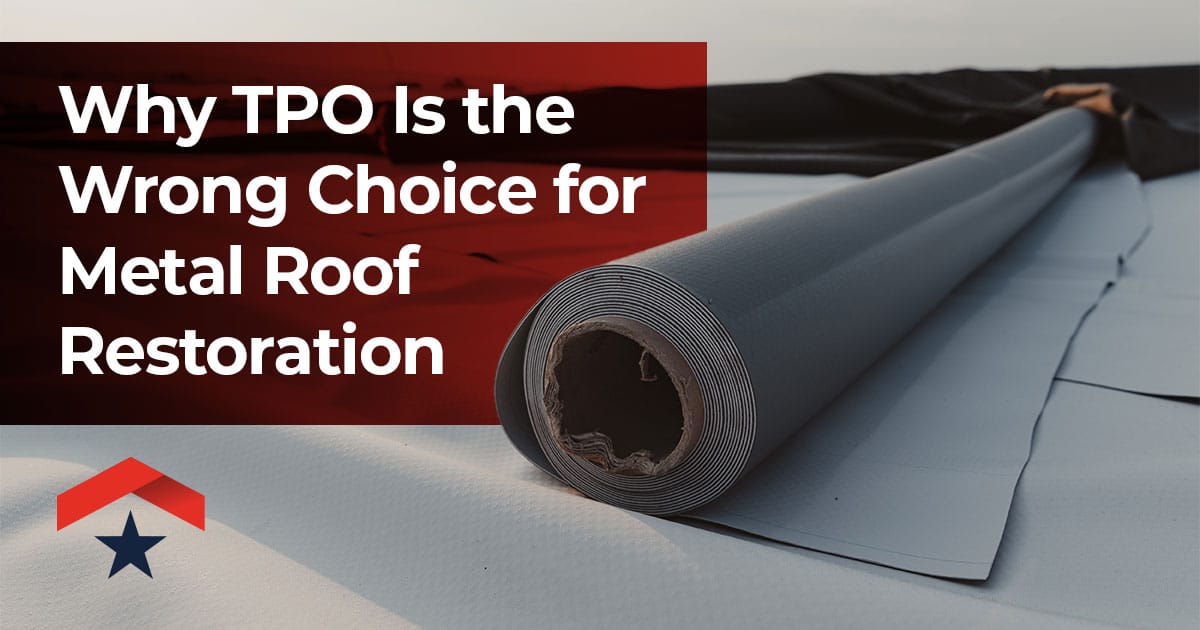
If you are weighing a TPO proposal for metal roof restoration on a Central Florida building, you are looking at a membrane built for flat decks, a material with documented heat sensitivity, and a system that changes how your building carries water and wind. TPO works well in the right setting. Draped over corrugated or standing seam metal panels in Florida’s heat, it is rarely the right setting.
The short answer: TPO is the wrong choice for most metal buildings because:
- TPO’s documented failures cluster around high, sustained heat
- Installing it over metal requires flute fill, insulation, and fasteners driven into every purlin
- A membrane erases the drainage channels your metal panels were designed around
- Manufacturer guarantees on membrane retrofits over metal top out at 20 years
- PVC is the stronger membrane, and a metal roof-over outlasts both
Here is what Central Florida owners and facility managers should understand before signing a membrane proposal for a metal roof.
What Does TPO Over a Metal Roof Actually Involve?
A TPO metal retrofit is a full rebuild of the roof surface, not a simple overlay. According to GAF’s metal retrofit guide, a typical installation includes:
- Foam flute filler cut to fit snugly between the ribs of every metal panel
- A layer of rigid insulation or cover board to create a flat surface
- Fasteners driven through all of it into the structural purlins, not the panels
- Fastener pullout testing and, often, added purlin bracing on through-fastened roofs
- Heat-welded seams across the entire roof
GAF recommends a licensed design professional evaluate the structure first, because exposed-fastener panels often brace the purlins themselves. Every one of these steps adds cost, time, and new failure points to a building that already has a functional steel roof system.
Why Is TPO a Risky Choice for Metal Roof Restoration in Florida Heat?
TPO has a large installed base, but its weak point is heat. In a Professional Roofing study of TPO longevity, published by the National Roofing Contractors Association, the authors found clear evidence of heat-related TPO failures where heat buildup ran beyond normal expectations, including roofs next to taller reflective surfaces and roofs with heavy dirt buildup.
The same research shows how quickly heat shortens service life. A TPO membrane projected to last 25 years at a sustained 160 degrees Fahrenheit was projected to last only about 12 years at 200 degrees. The authors also noted that TPO membranes vary widely between manufacturers, and that many manufacturers write a sustained temperature limit into their warranties or installation manuals.
Central Florida stacks the conditions that push TPO toward those limits:
- Long, intense summers with high solar loading
- Dirt, pollen, and mildew that darken a white membrane and absorb heat
- Taller metal walls, parapets, and rooftop equipment that reflect heat onto the roof
- Strict warranty maintenance conditions, which typically require bi-annual documented inspections by a licensed contractor—a clause manufacturers often cite to void claims
TPO also has a shorter track record. It became commercially available in the U.S. in the early 1990s, according to the same NRCA-published study, which means the industry is still learning how its formulations age.
How Does a Membrane Change the Way Your Metal Building Handles Water and Wind?
A metal building is engineered as a system. The panels, purlins, and frames work together, and the roof panels channel water down their flutes in predictable, evenly distributed paths.
A membrane changes that. GAF’s retrofit guide notes that once a single-ply membrane covers metal panels, water is no longer confined by the panel seams. Clogged gutters, deflected panels, or a membrane billowing in high wind can produce ponding and uneven loading on a structure designed for balanced loads.
Wind coverage is the other concern for Florida owners. The same guide caps metal retrofit guarantees at 20 years, with standard wind speed coverage of 55 mph and enhanced coverage up to 72 mph only on eligible projects with written approval. During hurricane season, that is a meaningful gap between what the warranty covers and what the building faces.
If You Want a Membrane, Why Is PVC the Better Choice?
If an owner is set on a membrane, PVC is the stronger option. Roofing Contractor reports that PVC roofing debuted in Europe in the 1960s and reached the U.S. in the 1970s, giving it roughly two decades more field history than TPO. PVC also brings strong chemical and fire resistance, which matters on buildings with exhaust vents, grease, or rooftop equipment.
PVC is not perfect. Its plasticizers migrate out over the membrane’s life, gradually making it more brittle. And over a metal roof, PVC still requires the same flute fill, insulation, purlin fastening, and 20-year guarantee ceiling as TPO. It is a better membrane, but it is still a membrane sitting on a building designed for metal.
Why Does a Metal Roof-Over Outlast Membranes on a Metal Building?
A metal roof-over is the most durable form of metal roof restoration because it restores a metal building with the material it was designed for. Roof Over America installs a custom-engineered 16-gauge sub-girt frame directly over the existing panels, fastened into the steel purlins, then installs new 26-gauge Galvalume Plus panels with long-life ZAC fasteners.
That approach delivers advantages a membrane cannot match:
- Longer service life. Galvalume Plus panels are engineered to last 30 years or more and carry a 25-year manufacturer warranty.
- No membrane heat aging. Metal panels are not subject to the heat-related membrane failures documented in TPO research.
- Natural drainage stays intact. New panels shed water down their ribs just as the original system was designed to.
- Cooler interiors. The air space between the old and new roof reduces heat transfer into the building.
- Zero downtime. No tear-off means operations continue throughout the project.
The Metal Building Manufacturers Association publishes a Roof Retrofit White Paper comparing common methods of retrofitting existing metal roofs, a useful reference for owners and engineers evaluating options. For buildings where wall panels are also failing, a full PEMB restoration can address the entire envelope at once.
TPO vs PVC vs Metal Roof-Over: How Do They Compare?
| Factor | TPO Over Metal | PVC Over Metal | Metal Roof-Over |
|---|---|---|---|
| Heat performance | Documented heat-related failures | Better, but plasticizers migrate over time | No membrane to heat-age |
| Field track record | U.S. since the early 1990s | U.S. since the 1970s | Roof Over America installing since 1983 |
| Prep over existing metal | Flute fill, insulation, purlin fastening | Flute fill, insulation, purlin fastening | Sub-girt frame into existing purlins |
| Drainage | Water no longer guided by panel ribs | Water no longer guided by panel ribs | Panel ribs carry water as designed |
| Typical warranty ceiling | 20 years over metal | 20 years over metal | 25-year manufacturer warranty, 30-plus year design life |
| Best for | Conventional flat decks | Flat decks with chemical or grease exposure | Most aging metal buildings |
When Does a Single-Ply Membrane Make Sense?
Membranes are a proven solution on conventional low-slope decks, the kind found on concrete, wood, or steel deck buildings with no metal panel roof underneath. For those roofs, Roof Over America installs TPO and PVC membranes and will recommend the system that fits the building.
The problem is applying a flat-roof solution to a metal roof. If your building has metal panels, the panels are telling you what the roof was built to be. As we covered in our guide to choosing restoration over replacement for a Central Florida PEMB, working with the existing structure is usually the most economical path. And if you are also weighing foam, our breakdown of spray foam roofing problems covers the risks of that option.
Frequently Asked Questions
Can you put a TPO roof over a metal roof? Yes, but it requires flute filler, insulation or cover board, and fasteners driven into every purlin. GAF’s retrofit guide limits manufacturer guarantees on these systems to a maximum of 20 years.
How long does a TPO roof last? It depends heavily on formulation and heat exposure. Research published by the NRCA projected that a membrane good for 25 years at a sustained 160 degrees would last about 12 years at 200 degrees.
Is PVC better than TPO? For most commercial applications, PVC has a longer track record and stronger chemical and fire resistance. Over a metal roof, however, both face the same installation complexity and warranty limits.
What is the best metal roof restoration option for a metal building? For most aging metal buildings in Central Florida, a metal roof-over delivers the longest service life, keeps the building’s original drainage design, and avoids any business downtime.
Will a metal roof-over disrupt my business? No. Because the existing roof stays in place, operations continue throughout the installation.
If a contractor has quoted TPO for your metal building, get a second opinion on metal roof restoration built around how your building was designed to perform. Contact Roof Over America to schedule a roof assessment and a straight recommendation from a team that has restored Central Florida metal buildings since 1983.
Get Started
Related Posts
Categories
Get STarted
"*" indicates required fields